
Japanese Design Archive Survey
DESIGN ARCHIVE
Designers & Creators
Naoto Fukasawa
Product Designer
Interview: 21 January 2026, 11:00–12:30
Location: NAOTO FUKASAWA DESIGN
Interviewee: Naoto Fukasawa
Interviewers: Keiko Kubota, Yasuko Seki
Author: Yasuko Seki
PROFILE
Profile
Naoto Fukasawa
Product Designer
1956 Born in Yamanashi Prefecture
1980 Gaduated from the Department of Product Design at Tama Art University
Joined Suwa Seikosha (now Seiko Epson)
1989 Moved to the United States; joined ID Two (now IDEO)
1996 Returned to Japan; established IDEO Tokyo
1999 Launched ‘WITHOUT THOUGHT’
2003 Founded NAOTO FUKASAWA DESIGN
2006 Founded ‘Super Normal’ with Jasper Morrison
2006 Appointed Director of 21_21 DESIGN SIGHT
2007 Awarded the title of Royal Designer for Industry (Royal Society of Arts)
2012 Appointed Director of the Japan Folk Crafts Museum
2014 Appointed Professor in the Department of Integrated Design at Tama Art University
2018 Recipient of the Isamu Noguchi Award
2022 Established THE DESIGN SCIENCE FOUNDATION
2024 Appointed Vice-President of Tama Art University
Received the Collab Design Excellence Awards, Philadelphia Museum of Art
2026 Received the Minister of Education, Culture, Sports, Science and Technology's Art Encouragement Prize
German Design Award Personality of the Year 2026
Description
Description
Although AI now makes it possible to transcribe interview recordings automatically, I still take the time to listen to the tapes again and transcribe the audio myself. This is because, when I immerse myself in the auditory world of the audio alone, I sometimes notice the interviewee’s unique words, turns of phrase and way of structuring their arguments—details I might have overlooked during the interview—and these insights have a significant impact on the process of compiling the text.
Interviews with Naoto Fukasawa reinforce this feeling. His words and narrative possess a profound, enveloping breadth and depth; beneath the surface, it feels as though he is offering a pause—as if to say, ‘That is what I think, but what do you think?’—giving the listener space to reflect a little more deeply. In this, one senses Fukasawa’s ‘quiet conviction’ regarding his own design, philosophy and actions, alongside a ‘trust in intuition’ built upon a wealth of experience and encounters.
In the 1980s and 1990s, when designers of fukasawa’s generation—those born in the 1950s—began to make their mark, Japan was transitioning from the euphoric period leading up to the bubble economy to a period of calm following its collapse, as digitalisation advanced and awareness of resources and the environment grew, making it impossible to carry on with the same ‘go-go’ attitude as before. It could be said that design, being so closely intertwined with society and the economy, was facing a paradigm shift that required a fundamental re-examination of its very meaning. It was precisely during this period that fukasawa found himself in the cutting-edge environment of Silicon Valley, far from Japan, exploring the next frontier of design.
And since returning to Japan in the mid-1990s, he has steadily given form to the insights he had accumulated up to that point. This is nothing less than the realisation of the vision fukasawa described in this interview: ‘Changing society gradually, like a tanker turning slowly as its small dials are turned little by little. Those who understand the situation take the lead in turning those small dials, and those who empathise with them follow. In this way, society changes little by little, and design changes with it.’
One of these is ‘design as action’, which questions designers’ attitudes and approaches to design, as seen in concepts such as design thinking and WITHOUTO THOUGHT. The other is ‘design as form’, an exploration of the ordinary, the supernormal and universality, born of the fusion between scientific insights—such as affordance—and fukasawa’s intuition. His practice has slowly but surely steered Japanese design in a new direction, much like a ship changing course. Fukasawa is now at the very stage of integrating these two approaches.
On this occasion, in the sun-drenched second-floor living room of NAOTO FUKASWA DESIGN, facing a row of cherry trees—a space where one is fully immersed in the world of Fukasawa—we spoke with him whilst experiencing what he calls ‘purposiveness without purpose’, to discover what lies beyond this integration.
Masterpiece
Major Works
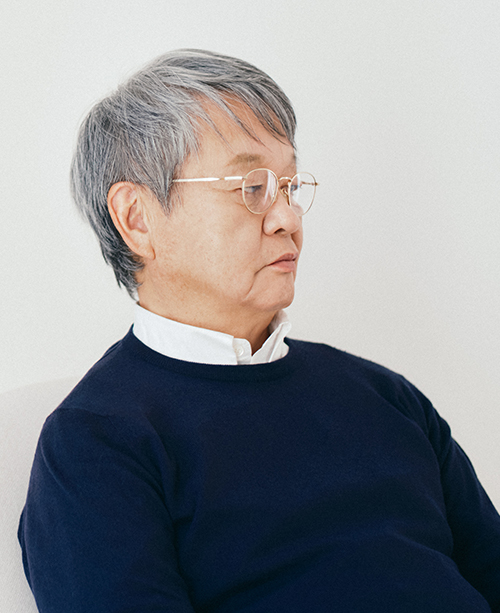
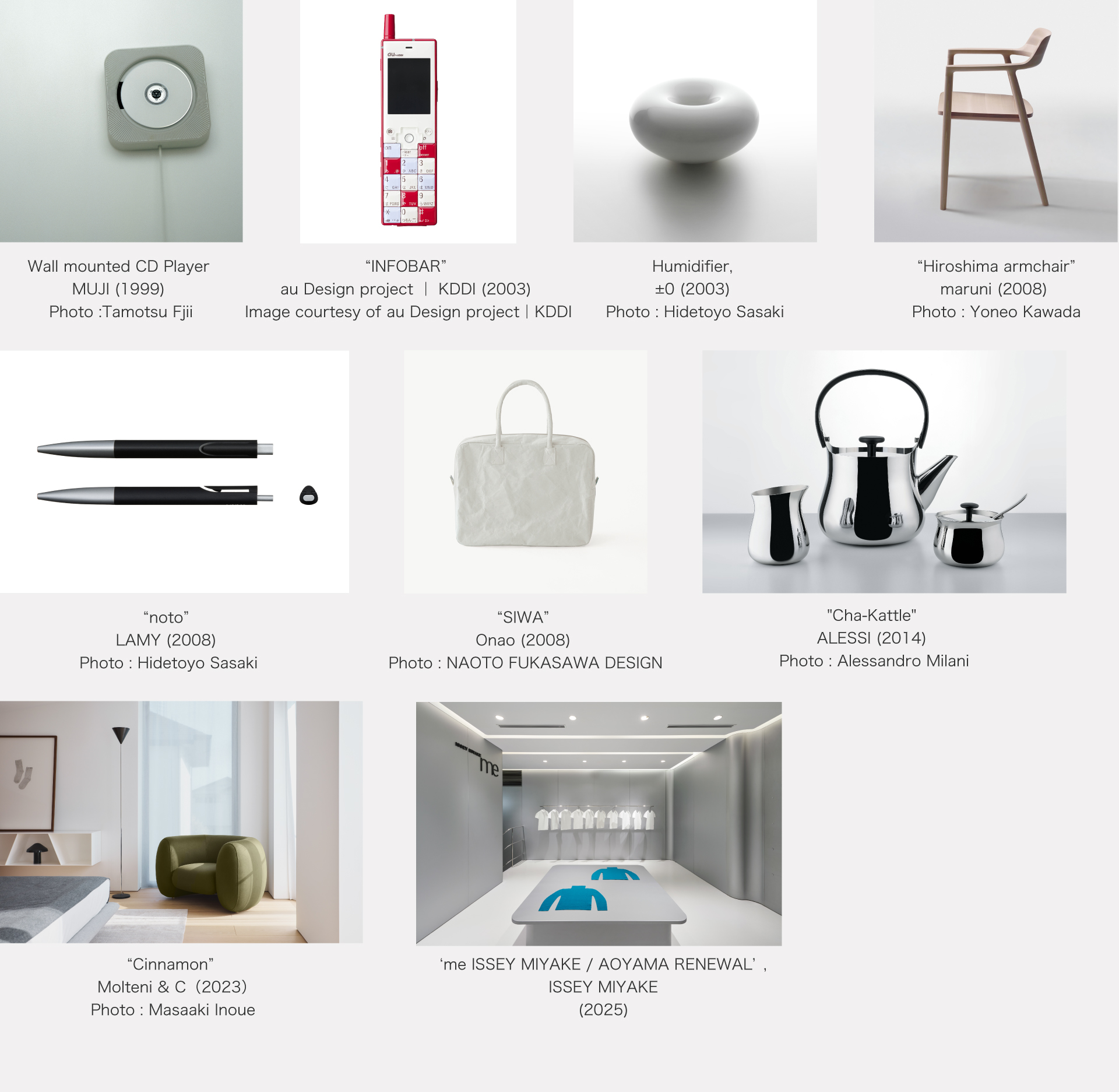
Wall mounted CD Player MUJI (1999), “INFOBAR” mobilephoneau/KDDI(2003), Humidifier ±0 (2003), “Déjà-vu” stool MAGIS (2005), “Shelf X and Shelf” B&B Italia (2005), Lighting “Wan” Yamagawa (2005), Wristwatch “TWELVE”, ISSEY MIYAKE / Seiko Watch (2005), Toilet “A・La・Uno” Panasonic (2006), Washi Paper Products “SIWA | Kamiwa” Ohnishi (2008), Armchair “HIROSHIMA”maruni (2008), Bath “Sabbia” Boffi (2008),Ballpoint pen “noto” LAMY (2008), Lighting “Modify” Panasonic (2009), Lounge chair “Grande Papilio” B&B Italia (2009), Side table “Marbelous” Marsotto edizioni (2010), “ELLIPSE” wrist watch ISSEY MIYAKE / Seiko Watch (2011), Hard carry case, MUJI (2011), Kitchen appliance series MUJI (2014), “Cha” kettle ALESSI (2014),“HF-1” lift Hitachi Building Systems (2015), Glassware TG (2018), Armchair “KOTAN” CONDE HOUSE (2022), Chair “Asari” Herman Miller (2023), Chaise longue “Tuscany”, armchair “Cinnamon” Molteni & C (2023), Chandelier “Mokuren”, Lladró (2023), Door handle “Dolmen”, OLIVARI (2025)
Publications
“Oputium”, Rikuyosha (2004)
“The ecological approach to design”, Tokyo Shoseki (2004) Co-author:Masato Sasaki Takeshi Goto
“Outline in Design”, TOTO Publishing (2005)
“Super Normal: Sensations of the Ordinary”, Lars Mueller (2007) Co-author:Jasper Morrison
Portfolio:“NAOTO FUKASAWA”, Phaidon Press(2018)
“Ordinary”,D&Department Project(2020)
“DESIGN SCIENCE_01”, “DESIGN SCIENCE_02”,“DESIGN SCIENCE_03”,Gakugei Mirai-sha, (2023–2025)
“Naoto Fukasawa’s Atelier”,Heibonsha,(2023)
Interview
Interview
Our Generation’s Task Is
to Draw a True Vision of the Future
From Yamanashi to the World
ー I’d like to ask you about what led you to become a designer.
Fukasawa As a child, I often missed school due to childhood asthma, so I spent my time at home drawing and doing craft projects. My father ran an electrical company, and as our home was on the second floor, I used the construction materials and tools lying around as toys. Seeing me like that, my parents seemed to think it would be better for me to take over the family business rather than study hard to go to college. However, as I grew older and became healthier, I transformed into a sports-mad teenager by the time I reached secondary school; I became particularly obsessed with basketball and threw myself into the school club. I attended a high school renowned for its basketball team, and with the family business in mind, I enrolled at a technical college specialising in electrical engineering, where I was among the top students in my class. I remained passionate about the club there too, but in the spring of my third year, after my final high school match had finished and I’d finally started thinking about my future, I picked up an entrance exam magazine in the library and the word ‘designer’ leapt out at me. I’ve loved crafts and drawing since I was little, and I’ d always vaguely aspired to be an artist, but of course my parents were against it, and I also felt it would be difficult to make a living as an artist. Realising that as a designer I could make the things I loved and earn a living, I had an instant gut feeling: ‘This is it!’ I immediately persuaded my parents and set about studying, but as I was ill-prepared, I had to take a gap year. I then came to Tokyo and began serious studies at the Ochanomizu Art Academy (Ocha-bi). It was there that I met all sorts of people and began to gain an understanding of the design world and what it meant to be a designer.
ー Why did you choose to specialise in product design at Tama Art University?
Fukasawa Design is generally seen as a choice between graphic design and product design, but from an industrial perspective—or perhaps because I was interested in form—I decided that product design would be more comprehensive. However, this turned out to be a major turning point in my career as a designer.
During my university days, I felt like I’d finally broken free from my parents’ home and was letting my hair down. (Laughs) Yamanashi Prefecture borders Tokyo, but as it’s surrounded by mountains, there’s a strong sense of ‘I’m going over the mountains’, and once you’ve crossed them, most people don’t come back. Back then, Yamanashi was a place where design was completely unheard of.
ー That said, after graduating from university, you joined Suwa Seikosha (now Epson) in Nagano Prefecture, a company surrounded by mountains.
Fukasawa That was because I was interested in sophisticated, meticulously crafted products, and also because I happened to do an internship at Suwa Seikosha (hereinafter Seiko). Around 60 students from all over the country gathered for the internship and spent a week holed up working on assignments. A competitive spirit developed among the participants, and I worked hard not to be outdone—as a result, I was selected as one of the top three. After that—I suppose you might call it ‘headhunting’—I was given paid assignments every week. I took them very seriously, and apparently, even before I’d joined the company, rumours were circulating that an exceptionally talented new recruit was on the way. That’s how I came to join Seiko. Nagano Prefecture is blessed with the magnificent natural scenery of Mount Yatsugatake, Lake Suwa and the Japanese Alps, so I was able to enjoy an active outdoor life, and I’m still greatly influenced by nature to this day.
ー Were you involved in watch design at Seiko?
Fukasawa That’s right. Back then, watches were still in the analogue era and were closer to works of craftsmanship than industrial design. The person who transformed that situation was Tsuneya Nakamura, the president of the company at the time. He led the development of the quartz timing devices used at the 1964 Tokyo Olympics and later headed the team that brought the world’ s first quartz wristwatch to market. He was also deeply passionate about design.
Following these technological breakthroughs, the mainstream in watchmaking shifted from mechanical to quartz, and Seiko transformed from a precision instrument manufacturer focused on watches into the comprehensive digital precision instrument manufacturer known today as Epson. In the mid-1980s, I was reassigned to develop new products and businesses utilising digital technology. Although the digital sector accounted for only about 10 per cent of sales at the time, there was a clear vision to create a new industry by fusing microtechnology with digital technology.
ー So, what sort of work were you doing there?
Fukasawa Seiko had shifted significantly towards digital technology, but when it came to the question of ‘what products should we make?’, there were few people within the company who could visualise concrete concepts or come up with ideas for new areas of design, such as user interfaces. As I was a newcomer, I naturally picked up digital and interface design whilst working at Seiko, learning independently from leading electronics manufacturers such as Sony. On top of that, President Nakamura, who loved design, took a particular interest in me and would come straight to me with all sorts of ideas, bypassing the department heads and section managers. For example, a wristwatch that could show TV programmes… something that has now been realised with the Apple Watch, but I was the one who visualised these unique his ideas. Sometimes he would invite me to his home, where we would have very frank discussions. He is one of the people who has had a profound influence on my life.
ー You were clearly held in high regard by the president and seemed to have everything going for you. What made you decide to set your sights on a career abroad? And what led you to choose ID Two, led by Bill Moggridge?
Fukasawa There were several factors involved, but one of the triggers was ”AXIS” magazine.
ー Really?
Fukasawa That’s right. After reading articles in ”AXIS” magazine about overseas firms and designers, I started thinking I’d like to go abroad to gain some experience. I put together a portfolio with the intention of going for an interview at a German company called Frog Design (hereinafter Frog), which was in the process of expanding into Tokyo, and I went to consult Eiji Hayashi, who was the editor-in-chief of ”AXIS at the time. He agreed to meet with me, and as I was leaving, he said, ‘You might just make it,’ which I felt was a real boost.
I then had an interview with Hartmut Esslinger, the boss of Frog, who was visiting Tokyo. As he looked through my portfolio, he said he couldn’t make the decision on his own and asked if he could keep it for a while. He then discussed it with staff in Germany and California, and we eventually agreed that, whilst he couldn’t hire me at that time, we would stay in touch. When my portfolio was returned, it was in tatters, and I realised they’d really taken the time to look at it properly. That gave me the confidence that I could make it overseas.
ー And so you ended up joining ID Two. How did that come about?
Fukasawa I became interested when I learnt that the British design firm ID Two had opened an office in California. I was intrigued by their approach of specialising in interface and interaction design to suit the local context of Silicon Valley, whilst also operating as a multidisciplinary practice that incorporated software and engineering. I immediately revamped my portfolio and went to meet the boss, Mr Moggridge. He had a gentlemanly demeanour typical of a Briton and was one of the first in the world to focus on interaction design.
I believe my ability to pick up on cutting-edge global trends and put them into practice was largely influenced by my experience at Seiko, where I visualised cutting-edge technologies, my time working with President Nakamura, and the impact of AXIS magazine. From the 1990s onwards, this field underwent rapid development during the seven years I spent in the US, starting in 1989. This coincided perfectly with a transitional period in industrial design, where the focus shifted from physical form to software such as GUIs (Graphical User Interfaces), much like the shift in watch design from craftsmanship to digital technology.
ー You moved from ID Two to IDEO and continued your design work in the US. What role did you take on there?
Fukasawa I was fortunate that, thanks to my father working in the electrical industry, I had a grounding in electrical and electronic engineering. I’d already learnt to draw technical drawings at technical college and understood structural and electronic principles. Because of that foundation, I was able to make a smooth transition even as the design process and tools shifted to computers. Also, having worked on watches at Seiko, I was particularly skilled at designing fine details at ID Two, and was known as the ‘King of Details’. (Laughs) Although it wasn’t made public, I worked on a project with Jonathan Ive from Apple, and as there were few Japanese people in Silicon Valley at the time, I was quite a well-known figure there. Of course, I was also in charge of communications with Japan, and I was there when you and the others came for the AXIS interview.
ー I visited the IDEO office; both the city and the office were wonderful, and I was envious of how lively and happy everyone seemed to be at work.
Fukasawa That’s true. Design firms like Frog and IDEO have offices all over the world and were involved in global, cutting-edge projects. When I was in Japan, whenever I saw articles about them in magazines, I envied their spacious offices and the way they worked and lived in homes that resembled lakeside resort hotels. I found myself wanting to be in such a privileged environment, both in terms of time and space.
ー What did you learn at IDEO?
Fukasawa I think it was about my second year at ID Two when several organisations—centred around ID Two, which focused on design, and the engineering firm led by David Kelley—merged to form IDEO. Mr Kelley founded the Hasso Plattner Institute of Design (d.school) at Stanford University and remains a managing partner at IDEO to this day. It was a great pity that Mr Moggridge passed away so young, but as the founder of the d.school and the originator of design thinking, Kelley is now a superstar at Stanford University and is widely respected. I felt truly fortunate to have been among the first at IDEO to experience design thinking, and the first thing I did upon returning to Japan was to adapt it to suit the Japanese context and put it into practice. That said, it differs from the current, somewhat trendy version of design thinking.
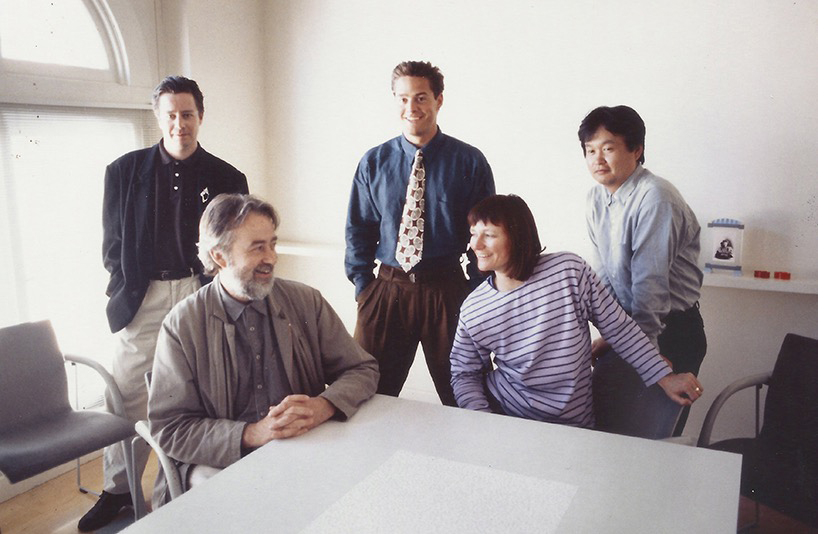
ID Two (now IDEO) team 1989 : (back row, from left) Tim Brown, Chris Loew, Naoto Fukasawa (front row from left) Bill Moggridge, Jane Fulton Suri. Photo : Courtesy of IDEO
ー So, despite being in such a privileged environment, you decided to return to Japan.
Fukasawa Well, I am a Japanese designer, after all. I was struck by something David Kelley once said: ‘In America, engineers are the heroes; in Europe, designers are the heroes.’ I suppose he felt that way because he was a consummate engineer himself. But he also loved design and had a network of European designers. When I told him I was returning to Japan, he even went so far as to introduce me to leading figures such as Ettore Sottsass, Michele De Lucchi and Antonio Citterio, saying I should meet them.
ー Was that what led you to expand into Europe?
Fukasawa When I put together a presentation of my work at IDEO to serve as my business card, they reacted with a ‘Wow!’, and that gave me the confidence that I could make it in Europe if I went independent. Looking back, I feel that it was only after my time at Seiko and ID Two/IDEO that the world finally came into view for me as a designer.
Opening Doors with ‘WITHOUT THOUGHT’
ー But after returning to Japan, you served as the head of IDEO Tokyo for a while, didn’t you?
Fukasawa David suggested to me, ‘If you’re coming back to Japan, why not set up an IDEO office in Tokyo?’ I hadn’t been unhappy during my seven and a half years at IDEO, and since they offered to rent us an office in the AXIS Building, I accepted the offer.
ー And you went on to lead IDEO Tokyo for the next six years.
Fukasawa The first thing I noticed upon returning from the US was that Japanese companies, which tend to rely heavily on in-house designers, are not very good at making effective use of external consultants. In the US, it was commonplace for large corporations to outsource projects by entering into exclusive contracts with firms like IDEO, but in Japan, the scale of budgets differed so greatly from that in the US that this approach simply wasn’t accepted. To expand our business in Japan, we needed to establish a Japanese-style approach.
So, I came up with the idea of me going into the companies myself and working alongside the in-house designers. ‘WITHOUT THOUGHT’ was the result of repeated trial and error as I tried to prepare fresh concepts and methods for every session. Subsequently, in partnership with Diamond Inc., this evolved into activities targeting the general public under the framework of the DMN DESIGN WORKSHOP. In short, I would go into companies, conduct workshops utilising the insights I’d gained at IDEO, and attempt to reset the mindset of in-house designers… essentially, I adapted IDEO-style design thinking to my own approach. I predicted that once their mindset changed, they would want to apply it to something else and would be keen to undertake more concrete projects. However, as this process requires a certain amount of time and money, it is difficult to sustain it within the design department alone. Consequently, we ended up involving the business division, which had the effect of improving the project’s continuity and budget scale for us. Prior to this, our interactions with external parties were limited to the final stages of product development—essentially being asked to ‘draw a picture’—and were mostly one-off jobs. Therefore, in order to work in the IDEO style, we also needed to change this dynamic.
ー Back then, I attended a presentation by you on the design work carried out by NEC and IDEO Tokyo to develop a design language for computer hardware.
Fukasawa That was a major project aimed at creating a design language that would embody NEC Design’s identity; it was a prime example of WITHOUT THOUGHT in action. However, to ensure the project’s success in Japan, key figures within the company were essential, and the role played by Yasushi Sakakibara, who was head of design at NEC, was pivotal.
ー The effect of WITHOUT THOUGHT was immense; I believe it truly brought about a paradigm shift in Japanese design.
Fukasawa It was of great significance to me as well. True to its name, I believe it brought about a genuine shift in thinking—conceiving design based on the psychology and behaviour lurking beneath people’s conscious awareness. To put it another way, it went beyond the logical ‘design thinking’ of the IDEO school to focus on the ability to feel and perceive things—that is, on sensibilities such as design sensitivity and design sense—and I feel it differs somewhat from the design thinking that is currently in vogue.
Just right, ordinary, universality
ー In 2003, you finally established NAOTO FUKASAWA DESIGN and expanded into the global market.
Fukasawa Around that time, I launched a brand called “±0 (Plus Minus Zero)” in collaboration with the toy manufacturer Takara, with the aim of transforming Japanese household appliances. The name “±0” embodies the concept of ‘just right’—meaning neither too conspicuous nor too large or too small, but rather a ‘just right’ sense of being a tool within the living space. This became the catalyst for the subsequent boom in designer home appliances.
When I visited the Salone del Mobile in Milan during this period, I was already a well-known figure thanks to a feature on “±0” in “DOMUS” magazine. At that time in Italy, electrical manufacturers such as Brionvega and Olivetti were losing momentum, and so-called industrial design was in decline; consequently, there were few people like me who could design a wide range of products, from household appliances to furniture. Partly because I was the designer of “±0”, I immediately received commissions from European manufacturers such as Danese and B&B Italia.
ー It was around that time that you took over the creative direction of MUJI from Ikko Tanaka, wasn’t it?
Fukasawa I only met him once, a week before he passed away, so I don’t know the full details of why he recommended me. He was not only an outstanding designer but also a highly influential and decisive figure who brought people together to launch various projects and design movements. MUJI was one of them.
ー Regarding MUJI, your phrase ‘MUJI is enough’ has really stuck with me. Could you tell us more about that?
Fukasawa This phrase refers to MUJI’ s concept of “MUJI is enough.” The idea is that if someone cannot find anything they truly like in a department store and then comes to MUJI, they can discover a product at a fair price and think, “This is just right.” I believed that this was the kind of product we should aim for. MUJI is more than good enough. It is neither excessive nor insufficient; it simply feels right.
ー And then, in 2006, you collaborated with Jasper Morrison to convey the ‘Supernormal’ concept through exhibitions and books, which had a huge impact on the design world.
Fukasawa ‘Supernormal’ refers to a ‘normality’ that transcends time—something so ordinary that we don’t even notice it, yet we somehow grow attached to it and cannot part with it. It is a design rooted in the universality that lies at the very core of human nature.
The DASHI(=Stock) of design
or ‘purposiveness without purpose’
ー So, ultimately, what is the fundamental principle of design that you are striving for?
Fukasawa To put it in my own words, it feels like creating ‘DASHI’, the stock that forms the basis of all cooking. I believe that as long as you have delicious dashi, a chef simply needs to add salt and seasonings to create their own unique flavour, and design is no different. I call myself a ‘dashi designer’, but many manufacturers come to me looking for specific flavourings. (Laughs) Even so, I tell them, ‘No, the DASHI alone is delicious enough,’ so in Europe, it seems I’m recognised as ‘fukasawa designs icons = DASHI’.
ー Looking back, from ‘WITHOUT THOUGHT’ and ‘Outline of Design’, ‘Super Normal’ to ‘original’, ‘Mingei’ and ‘Integrated Design’, you have consistently focused on creating the ‘stock’ for your work.
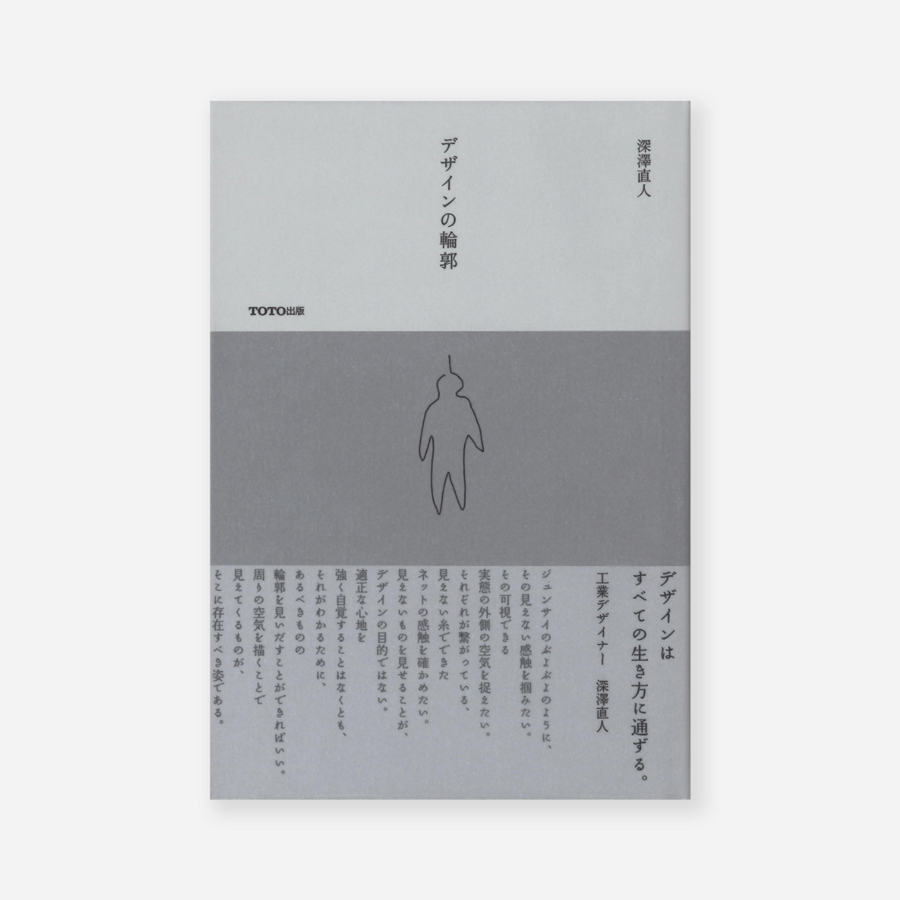
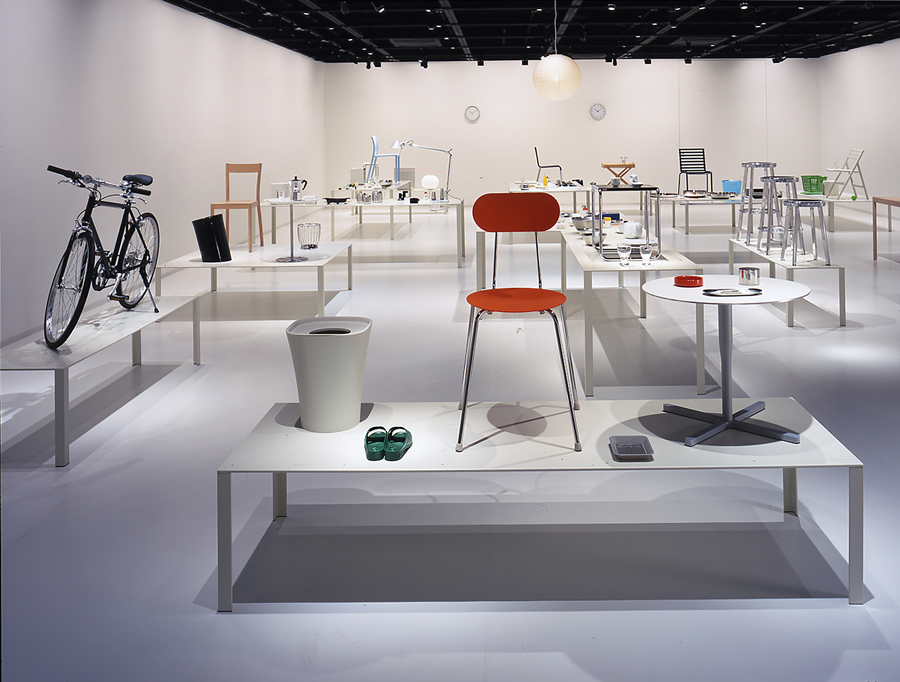
‘The Outline in Design’, TOTO Publishing (2005). Exhibition ”SUPER NORMAL”, at AXIS Gallery (2006) Photo :Atsushi Nakamichi , Nacása & Partners Inc.(right)
Fukasawa That’s right. If I can design a stock that everyone finds delicious, they can season it however their like afterwards.
ー Your approach serves as a driving force that shifts the focus of design concepts from form to consciousness and action.
Fukasawa Japan’s economic growth has been achieved through the pursuit of novelty, but what I have been feeling recently is what the philosopher Immanuel Kant (1724–1804, Prussia) referred to as ’purposiveness without purpose’. This is a concept he proposed as a ‘definition of beauty’ in his book ”Critique of Judgement”.
Before I encountered this term, I viewed the natural world as an ordered one. However, according to Kant, nature is chaotic. In this disordered and chaotic natural world, for example, the moment the evening sky is tinged with a beautiful purple hue, or the sight of a vast flock of starlings soaring against that sunset backdrop… people find such overwhelming scenes beautiful and are moved by them. Yet the natural world does not bring about such phenomena for the sole purpose of moving people. Whilst nature’s accidental phenomena cannot be analysed by computers or artificially reproduced, humans perceive beauty in nature’s complexity.
We are currently living in a chaotic world. Inequality, discrimination and war have become all too familiar. It is precisely because we live in such a chaotic world that, when we encounter a beautiful design—one that appears as if by chance, much like a phenomenon in the natural world—people’s hearts are moved, and they find themselves agreeing that it is truly wonderful. Of course, design is something created intentionally by humans, but when it touches upon something that seems to transcend human intent—something lurking beneath the surface of our consciousness—that design can be accepted by everyone… and so I arrived at Kant’s philosophy.
ー It’s starting to sound a bit like a Zen dialogue, isn’t it? (laughs)
Fukasawa (laughs) When you eat delicious Miso-soup every day, you don’t really stop to think about why it tastes so good, do you? I believe design needs to reach that level too. To put it another way, if eating delicious Miso-soup every day is ‘order’, then to truly appreciate it, you also need to experience the ‘chaos’ of eating bad Miso-soup. Applied to design, it means creating something that, although actually designed by a person, gives the impression that it wasn’t designed at all.
ー So, you design with these kinds of thoughts in mind.
Fukasawa Ever since I was a child, I suppose you could call me a bit of a contrarian—I’ve always had a very strong sense of scepticism, always asking, ‘Is that really true?’ Looking back now, I realise that chaos is actually the natural state of things, yet I felt a sense of unease about a world where a strangely orderly and structured atmosphere, and where people automatically read the room before speaking, had become the norm.
Admittedly, modern society is so inundated with information and problems that it’s impossible to engage with each one sincerely, but even so, I think a society where ‘active indifference’ is the norm is dangerous. ‘Active indifference’ means deliberately looking away, and as long as we do that, we’ll never find a fundamental solution.
What’s more, ever since I was little, I’ve had plenty of questions about everyday objects and tools, thinking, ‘That’s a bit odd’ or ‘Why is it like this?’ Now that I’ve become a designer and look at design masterpieces anew, I see that they contain clear, convincing answers. It’s not just me who sees this; anyone can. When you really get to the heart of it, these masterpieces exist here and now, transcending the designer’s original intent. My current theme is to express design in such a way that it doesn’t feel like something I’ve done. In other words, I think I want to make myself part of nature. After all, humans are part of nature.
ー Michelangelo once said, "The sculptor’s task is to discover and carve out the statue that is already contained within the stone." Is that what you mean by ‘becoming one with nature’?
Fukasawa He was a genius, after all; there’s even a story that, when faced with a huge block of marble, he began carving from the toes upwards. That must have been a state of mind where a force of nature beyond himself was at work. Isamu Noguchi spoke of something similar. He said that once, whilst carving a stone, it suddenly chipped away, but as the resulting form was so magnificent—transcending his own intentions—he decided to keep it as it was. In other words, something that could not be produced by his own strength alone was integrated into the work at that very moment.
ー Even if something beyond human understanding occurs, it is the designer who must recognise that moment.
Fukasawa Designers create through the medium of themselves, but that is not the objective. Because design is about creating tools for others to use... Whilst some designers are fixated on artistic self-expression, we—particularly product designers—are creating things that simply exist, things that are taken for granted.
Mingei, Cuteness, Natural Feel
ー You also serve as the director of the Japan Folk Crafts Museum. Does what you just said apply to folk crafts as well?
Fukasawa The spirit of Mingei is fundamentally the same as what we’ve been discussing. First of all, “Mingei” has no name, no creator, and we don’t even know where or how it originated. Mingei consists of the folk crafts that Muneyoshi Yanagi objectively discovered and collected. At a time when beautiful crafts adorned with gleaming gold leaf were highly valued, Yanagi declared, “No, that’s not it—it is the simple, unadorned craftsmanship itself that is beautiful,” and many people who shared his view gathered around him. He formed a collective with them and achieved the astonishing feat of amassing a collection of 17,000 pieces. Mingei consists of tools born from local craftsmanship using local materials and techniques, and anonymity is its foundation. In contrast, traditional crafts are a highly artificial world where skills are passed down through master-apprentice relationships, establishing expertise and the distinct identity of the artist.
ー From a product designer’s perspective, what is the appeal of Mingei?
Fukasawa I collect “A-un Komainu” (pair of guardian dogs), which were made by ordinary people for those close to them. While the individual pieces aren’t highly polished, each one has its own personality—they’re incredibly cute and charming. I also love Okinawan “Zushi-Game.” These are urns used to hold the bleached bones of the deceased after wind burial; women would wash the bones and place them inside. The shape of the house is adorable and full of love.
Since becoming director of the Japan Folk Crafts Museum and taking a comprehensive look at the collection, I’ve come to feel a deep affection for the items Yanagi collected—they may not be stylish, but they’re endearing, and I feel an urge to touch them. To draw a parallel with dashi, it’s as if you sprinkle a little magic dust onto an existing prototype to bring out its charm. In other words, it’s the imperfections that reveal humanity, and I think this resonates with a sense of naturalness.
ー How does your concept of “DASHI design” and a “natural feel” influence your work on a global scale?
Fukasawa Many designers focus on localization—that is, “seasoning”—but I operate on the premise of “WITHOUT THOUGHT,” which assumes that human physicality and thought are fundamentally shared at an unconscious level. I believe that as long as we have a DASHI that humans find delicious, simply adding curry or cream will naturally create a delicious flavor.
As globalization has expanded, there has been a renewed focus on the history and culture of specific regions. While this is certainly important, I design tools for people, and when you take that to its logical conclusion, the result takes the form of a universal “broth” shared by all humanity. For example, a door handle universally recognized as beautiful will enhance the quality of the architecture and space, regardless of regional differences like whether it’s European or Asian.
Toward Integrated Design
ー We’re currently conducting this interview in the living room on the second floor of NAOTO FUKASAWA DESIGN. This building and space truly represent the culmination of your design philosophy.
Fukasawa That’s right. This building integrates my design concepts and is fundamentally different from mass-produced homes that prioritize performance and cost-effectiveness above all else. Living here fosters a sense of tranquility; you don’t want to clutter the space with unnecessary items, and your aesthetic sensibilities are refined, leading you to desire a higher-quality experience. And when we engage in conversation while sipping delicious tea in this beautifully curated space, it becomes easier for others to appreciate high-quality design. In other words, it connects to the “purposiveness without purpose” I mentioned earlier—the experience here naturally leads people to that realization. However, this is not the case in Japan today, and that is a major challenge.

NAOTO FUKASAWA ATELIER is designed by Fukasawa himself. The interior is furnished with furniture and objects created by Fukasawa, creating an environment that is truly integrated in the Fukasawa style. Photos: Masaki Ogawa, Image courtesy of Pen magazine Published in the April 2022 issue
ー For example, I think that during Japan’s period of rapid economic growth and the bubble economy, people had a strong desire for better things, and that served as the driving force behind the evolution of design. But what happens now that people’s desires have diminished?
Fukasawa That said, the current standard of design has improved compared to the bubble era. That’s why many young people today can immediately grasp the world I’m describing. Also, since it’s harder to envision a bright future than it was during the bubble era, more people are seeking a way of life that is self-contained and integrated within their immediate surroundings. This is a completely different direction from the young people who lived through the period of high economic growth and the bubble era.
This is an important point for design. Rather than using a large steering wheel to drastically change the course of society, they are changing society gradually, like a tanker slowly changing direction by turning a small dial little by little. It’s not like in the past, where everyone acted in unison; instead, those who understand the situation take the lead in turning the dial, and those who empathize with the idea follow behind. The image is that society changes little by little in this way, and design changes along with it.
ー Design is created through the interaction between the designer, who creates it, and the user, who experiences it. While the designer has been influenced by you, what about the users?
Fukasawa In Japan, when measuring societal prosperity, economic indicators like GDP (Gross Domestic Product) tend to be emphasized. However, these merely indicate the “scale of economic activity” and do not directly represent “life satisfaction” or “happiness.” For this reason, in recent years, the importance of indicators such as well-being and quality of life (QOL) has been highlighted. In this context, the quality required of future designers is the ability to translate abstract concepts like well-being and ESG (Environment, Social, Governance) into concrete aspects of daily life and design.
On the other hand, what matters most to users is whether they are paying a fair price for a good life and design. In other words, it’s about having the mindset that “this is a lifelong companion.” In Japan, lifestyles change with each generation, and people tend to replace their furniture and appliances with new ones each time. However, even students can buy expensive items if they like them—and use them for a lifetime. In Italy, people eat with spoons meant to last a lifetime from childhood onward and live surrounded by buildings and furniture passed down from their ancestors. While Japanese buildings ensure safety and comfort, the cycle of replacing them as soon as they become old is repeated. Yet true safety and sustainability cannot be achieved through such short-term thinking.
ー What does MUJI mean to you now.
Fukasawa MUJI has recently begun to focus on the concept of “products for a lifetime.” If that’s the case, there’s no need for seasonal design strategies. Even a bottle opener—like the old Mitsuya Cider bottle opener—in other words, a super-normal tool, is perfectly sufficient. Unfortunately, Japan hasn’t reached that point yet, so shallow, copy-and-paste products and spaces are proliferating. That is the reality of modern Japan.
ー In that context, what kind of talent and education are you aiming for in the Department of Integrated Design you founded at Tama Art University?
Fukasawa Above all, “insight.” Whether it’s dashi stock or design, everyone has moments when they suddenly realize something. I want students to spend four to six years cultivating the “perspective” and “sensibilities” to discover as many of those moments as possible.
ー It says, “To nurture designers who can envision and bring to life a beautiful society, we are breaking down traditional disciplinary boundaries and starting from an integrated design approach.”
Fukasawa We’re aiming for something a bit lofty—a beautiful society, beautiful design—but our classes avoid becoming too abstract; instead, we use a project-based format to proceed in a very concrete way. The problem, however, is that the industries hiring them aren’t looking for anything that lofty, so within the employment system, they can’t fully utilize what they’ve learned. What’s interesting is that leaders at think tank-style firms and companies with advanced technology and resources are actively seeking graduates from the Integrated Design Department. They recognize their own weaknesses in these areas and are taking steps to delegate tasks they can’t handle to those who can, and to collaborate with them. This is something David Kelley’s IDEO and the d.school were among the first to put into practice, and I see a bright future in that trend.
ー Has this trend had an impact on your work?
Fukasawa Yes, it has. Recently, I’ve been approached for consultations by local governments, such as the prefecture and the city.
ー It sounds like you’ve been quite active in your home prefecture of Yamanashi.
Fukasawa The biggest project in Yamanashi right now is related to the maglev train; I’ve submitted proposals for the redevelopment of the area in front of Kofu Station, among other things. Generally speaking, when it comes to station-area development, consultants and developers tend to take the lead, which is why cities all over Japan are starting to look the same. I noticed from aerial photos that there was no greenery in downtown Kofu, so I proposed covering not only the station area but also the Linear’s bridge piers and other structures with forests. I believe that what our generation must do is present a vision that points toward a better future.
Design Archive
ー You’re active across the entire design world. What are your thoughts on your own archive?
Fukasawa My archive is stored here and in a warehouse (including prototypes). In my case, since I have many large products like furniture, I think it’s best for those to be kept by the manufacturers. In 2024, following my win at the Collab Design Excellence Awards hosted by the Philadelphia Museum of Art, I held the exhibition “Naoto Fukasawa: Things in Themselves” at the museum. For that, I had the manufacturers’ U.S. branches arrange for some of the exhibits. Ultimately, since I have to gather the archives—which are scattered among the designer himself, manufacturers, museums, and universities—on a case-by-case basis, I believe it’s essential to organize the information and data myself.
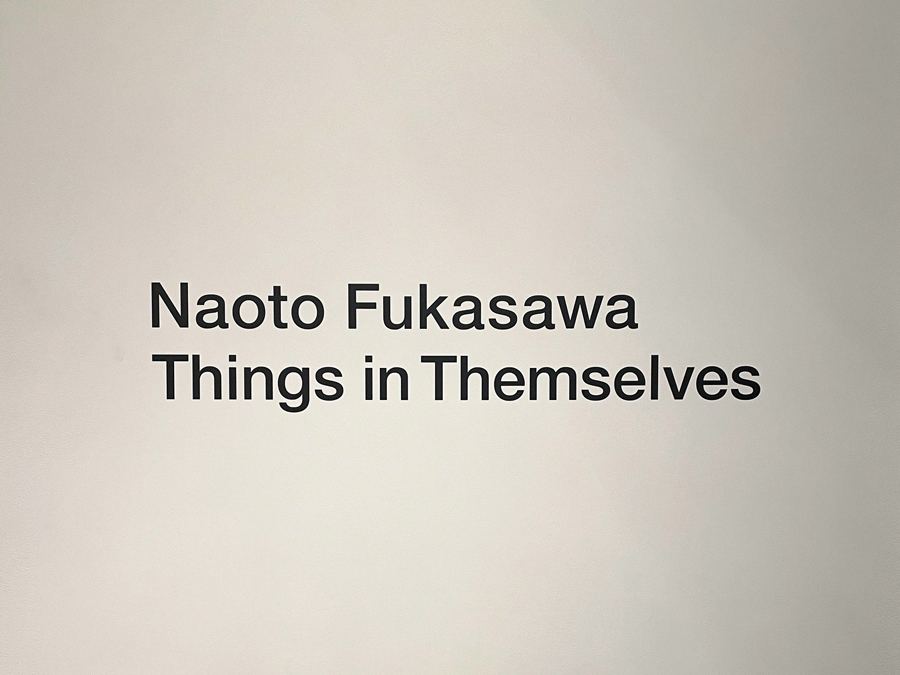
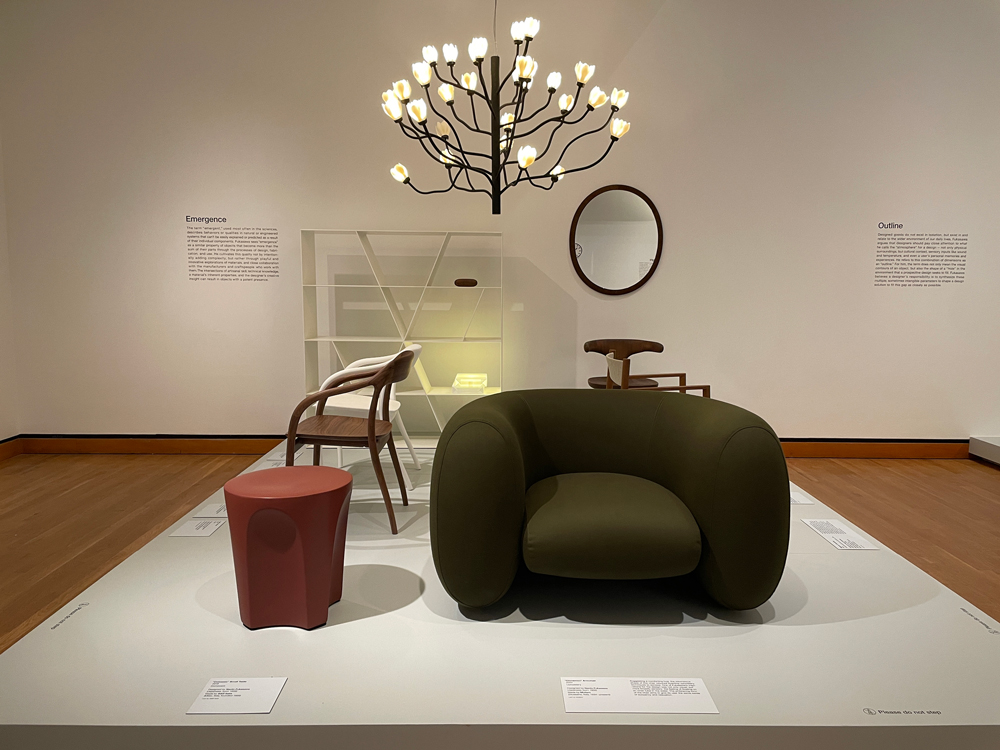
The exhibition “Naoto Fukasawa: Things in Themselves” was held at the Philadelphia Museum of Art to commemorate the 2024 Collab Design Excellence Awards. Photos : NAOTO FUKASAWA DESIGN
ー What about drawings, sketches, and models?
Fukasawa I have sketches, drawings, photos, and notes. I don’t sketch very often, but when I had my solo exhibition at the Philadelphia Museum of Art, I dug out some old sketches for the first time in a long while and looked them over. I was impressed that even though they were rough sketches, drawn in a single stroke, they clearly conveyed the concept. It struck me how I’d been creating products through back-and-forth discussions with manufacturers and craftsmen using sketches this simple.
ー What about drawings? Your generation experienced the transition from hand-drawn to digital design firsthand.
Fukasawa I haven’t gone out of my way to digitize my analog drawings, but that trend is certainly accelerating. Archives are meaningless if they aren’t used, but since people end up searching for them online anyway, they might not be put to good use unless they’re digitized.
ー How do you think digital technology and AI are influencing design?
Fukasawa The advent of digital technology has radically transformed design. No matter how excellent a design may be, it cannot be manufactured based on hand-drawn blueprints alone. After all, very few people on the production floor can read blueprints these days. On the other hand, if we see an increase in designers who are skilled in computers and digital technology and can create surfaces that look beautiful at first glance, I think that’s something we should be concerned about.
AI has already made its way into design as a tool. For someone like me who appears in the media, it’s easy for AI to produce “Naoto Fukasawa-style designs,” so I have no choice but to do something different to compete with it. However, when I ask the AI, “Who is Naoto Fukasawa?” it responds, “I don’t know his background,” so I wonder if I’m hiding my true self well for now? (Laughs) When I think about why that might be, it’s because my designs seek “essence” rather than a specific style, making them difficult to categorize—perhaps that’s why the AI struggles to recognize them.
ー What are your thoughts on design museums in Japan?
Fukasawa For me, design is meant for everyday use—it’s based on the premise that it will be used—so I don’t find simple exhibitions very interesting. In that sense, I think the current Salone del Mobile in Milan embodies elements of a design museum. That’s because the latest designs are displayed and presented in ingenious ways, and there are many members of the general public who come to enjoy the design itself, rather than for commercial purposes. The roughly 30 clients I work with are still doing their best, and I believe my work with them serves as excellent propaganda and promotion for design.
On the other hand, while it doesn’t quite fit Kant’s concept of “purposiveness without purpose,” having too many choices isn’t necessarily a source of happiness for humans; inevitably, having just one thing that emerges is sufficient. When you think about it that way, the path forward for what design museums should show people may become clear on its own.
ー It’s been four years since you founded “THE DESIGN SCIENCE FOUNDATION.” How has it been going?
Fukasawa The foundation was established with the aim of creating an environment where experts in design and science who explore creativity can guide the world toward a more beautiful future. Since it’s a foundation, we cannot engage in for-profit activities, so my company and I personally cover the operating costs. As for our activities, we invite individuals active in various fields—such as science, art, literature, and design—to participate in the DESIGN SCIENCE ACADEMY, a forum held both in person and online, where we present the PRIZE for LEADING CHARACTER. We also publish a book series titled “DESIGN SCIENCE,” compiling reports from the forum and essays contributed by experts from various fields; last year marked the release of the third volume. Takashi Yoro participated in the forum despite his busy schedule, and simply sharing that time and space with him was deeply fulfilling. That is my truth, and my way of preserving what is genuine. Since the world is currently full of fakes, I believe this is an era where authenticity is incredibly important. In theory, I could engage in a wider variety of activities, but I’m not very good at being part of a crowd… I need to find a way to overcome that.
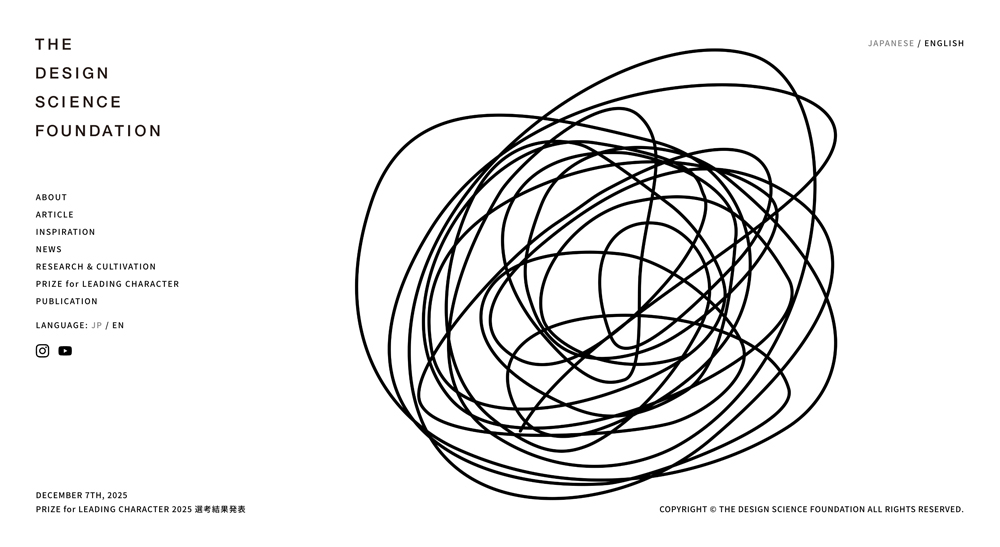
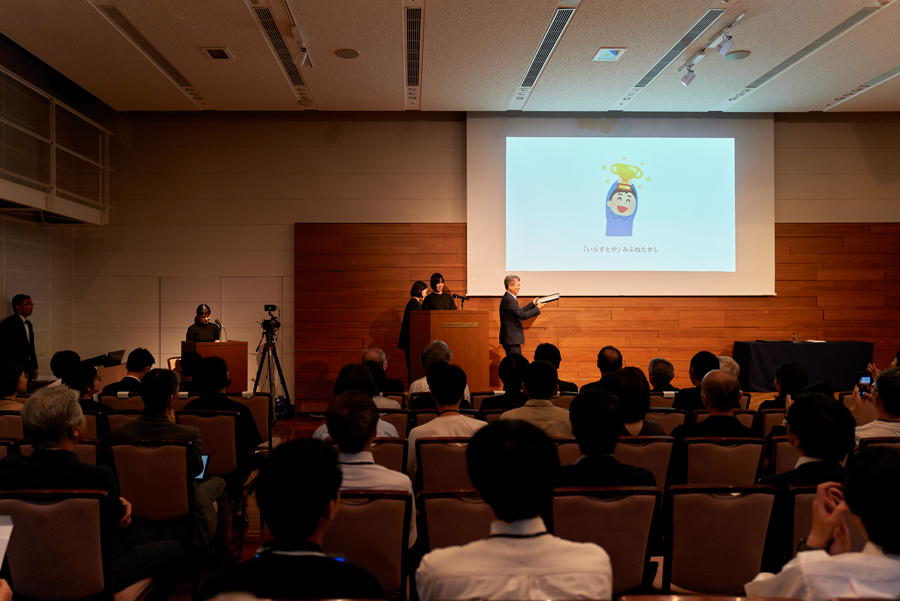
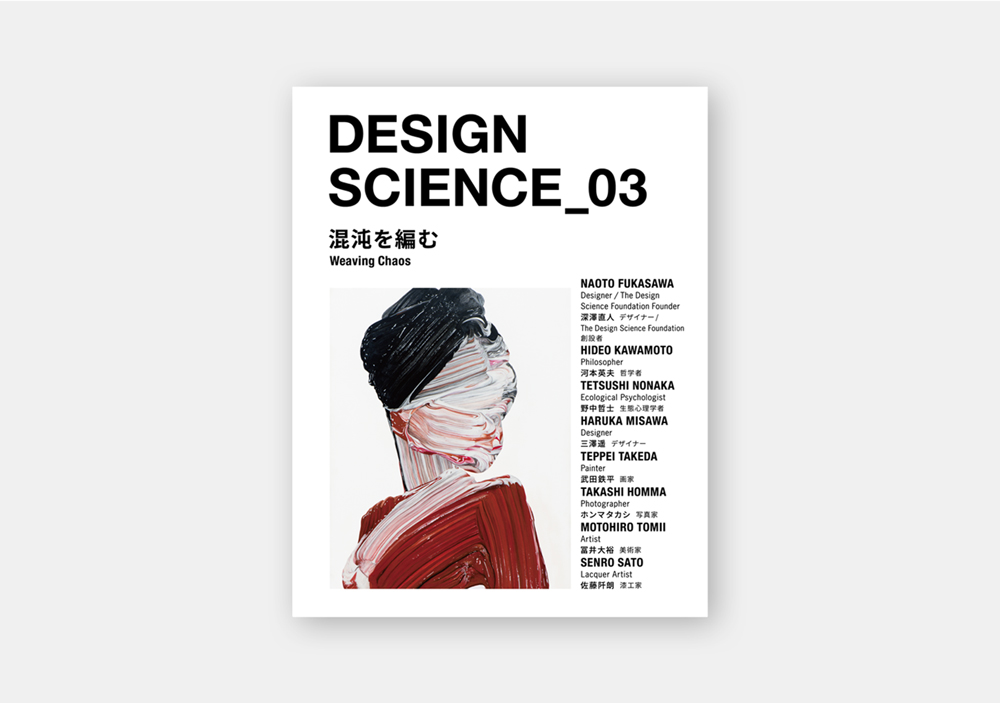
From left to right: the website of THE DESIGN SCIENCE FOUNDATION, a scene from the 1st DESIGN SCIENCE ACADEMY, and the latest issue of 『DESIGN SCIENCE_03』(2025 Gakugeimirai-sha) featuring the special topic “Weaving Chaos.”
ー Is there a possibility that the foundation might preserve and manage your archive in the future?
Fukasawa It’s possible, but that’s not why I established the foundation. I don’t see how that would serve the public interest as a foundation, and I haven’t given it much thought at this point. In reality, organizing an archive requires a tremendous amount of effort and time, and that legacy would need to be maintained. As a foundation, I’m interested in preserving an archive of design “knowledge” and “philosophy.”
ー One final question. Listening to the story of your career, I felt that there was not a single wasted effort or failure—everything has led to who you are today. Was that a strategic choice, or was it simply the result?
Fukasawa I’m not a strategist. (Laughs) My decisions are based on intuition. It’s just that afterward, I analyze in great detail why they were right—or why they weren’t. But I do believe it’s definitely better to go with your gut. In human life, every action boils down to a binary choice: life or death. That’s why ordinary human actions are essentially choices made to survive. So, right up until the very end, people are making choices that lead to survival. In that sense, I don’t think we fundamentally choose the wrong answer. So, whenever I’ve faced a decision, I’ve always judged it based on whether I felt it was “good” or “right” for me.
ー Do encounters with people and things also play a role in that judgment?
Fukasawa The reason I was able to make a good choice was that, leading up to that point, I felt a sense of frustration and hesitation—a feeling that it was time to move on—and that was the right moment to take the next step. If I were to rephrase that as “purposiveness without purpose”, perhaps the reason I was able to make that choice was because Bill Moggridge and David Kelley were right in front of me, and there was a sense of inevitability in being entrusted with MUJI by Ikko Tanaka and 21_21 DESIGN SIGHT by Issey Miyake. When I think about it that way, I feel like someone is watching me from somewhere, and we connect or draw each other in. In the end, it might all come down to people.
ー Thank you very much for the long interview today in the warm, sunlit room of the NAOTO FUKASAWA DESIGN, where we enjoyed delicious coffee. Your words were truly wonderful, Mr. Fukasawa. I look forward to your future endeavors.
Enquiry:
NAOTO FUKASAWA DESIGN
https://naotofukasawa.com

Home Archive Communication Education Exchange Proposal Research Company Membership Contact
Copyright © PLAT. All rights reserved